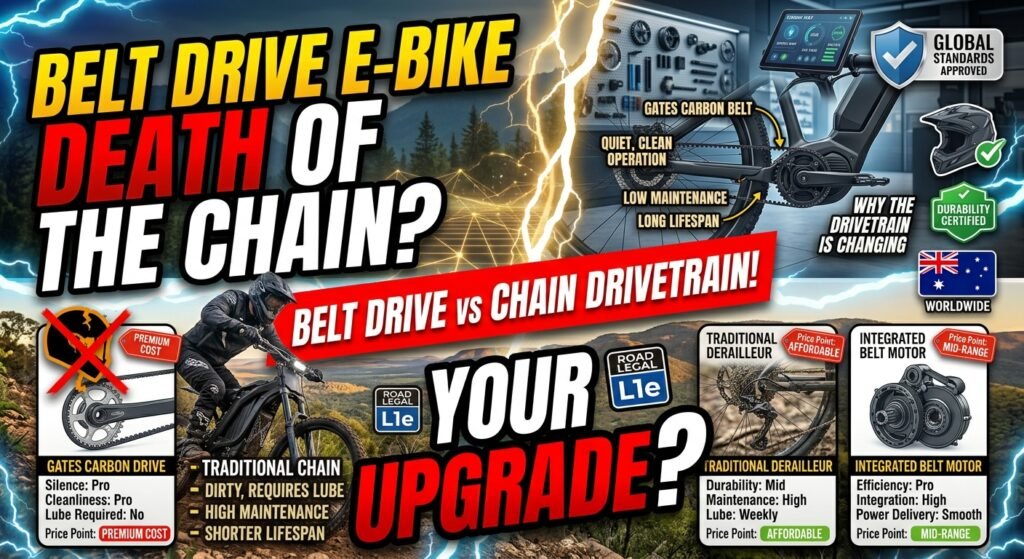
Belt Drive E-Bike vs Chain: Why the Drivetrain Is Changing
The Belt Drive E-Bike vs Chain debate is becoming increasingly important as electric bikes become more powerful. High-torque motors place substantially greater demands on drivetrains than conventional bicycles, making durability, maintenance, and power delivery critical considerations for serious riders.
Traditional chains and external derailleurs remain extremely effective. However, premium electric bikes are increasingly adopting carbon belt drives and internal gearboxes to create cleaner, quieter, and more robust drivetrains.
One of the most notable technologies is Pinion Smart.Shift, which brings electronically controlled shifting to Pinion’s internal gearbox systems. Pinion now offers Smart.Shift systems with 6, 9, and 12 gears, while its MGU combines the motor and gearbox into one integrated unit.
For riders who are tired of greasy chains, noisy shifting, derailleur damage, and regular drivetrain adjustments, this represents a significant evolution.
Why High-Torque Electric Bikes Are Harder on Drivetrains
Electric motors change the mechanical equation.
A powerful e-bike can produce considerably more torque than a rider can generate through conventional pedalling alone. That additional torque is transmitted through the drivetrain every time the motor assists the rider.
With a conventional chain-and-derailleur setup, this can mean increased wear on:
- Chain links
- Cassette teeth
- Chainrings
- Derailleur components
- Jockey wheels
- Shifting cables
That does not mean chains are unsuitable for electric bikes. Quality chains remain reliable when correctly selected, lubricated, and maintained.
The issue is that high-performance riders increasingly want a drivetrain that requires less intervention.
What Is a Carbon Belt Drive?
A carbon belt drive replaces the traditional metal chain with a reinforced toothed belt.
Gates Carbon Drive, for example, uses carbon-fibre reinforcement within the belt and does not require conventional chain lubricant. Gates describes the system as clean, quiet, strong, and low maintenance. It also does not rust like a conventional metal chain.
That creates an immediate advantage for riders who regularly ride through:
- Rain
- Mud
- Dust
- Gravel
- Coastal environments
- Off-road trails
Instead of cleaning and lubricating a greasy chain, a belt drive can generally be cleaned with water and appropriate care.
Belt Drive E-Bike vs Chain: The Main Differences
| Feature | Carbon Belt Drive | Traditional Chain |
|---|---|---|
| Lubrication | No chain oil | Regular lubrication required |
| Rust | Belt itself does not rust | Metal chain can corrode |
| Noise | Very quiet | Can become noisy |
| Maintenance | Low | Moderate to high |
| Mud resistance | Excellent | Requires more cleaning |
| Derailleur | Not required with internal gearbox | Usually required |
| Gear shifting | Internal/electronic possible | External derailleur common |
| Weight | System-dependent | System-dependent |
| Replacement | More specialised | Widely available |
| High-torque applications | Excellent with compatible system | Excellent when correctly specified |
The important point is that belt versus chain is only half the story. The gearbox behind the belt can be just as important.
Pinion Smart.Shift Gearbox: A Different Approach
The Pinion Smart.Shift gearbox moves the shifting mechanism away from the exposed rear derailleur.
Instead of multiple external gears and a derailleur hanging near the rear wheel, Pinion places its gearbox centrally within the bike.
Pinion Smart.Shift uses electronic controls and sensors to execute rapid gear changes. Its current system supports manual, semi-automatic, and fully automatic shifting functions.
That means riders can potentially shift:
- At a standstill
- Under load
- While climbing
- Automatically according to cadence and speed
Pinion states that its MGU can shift under load and that the gearbox is contained within a sealed housing.
For technical trail riding, that can be a major advantage.
What Makes an Internal Gearbox Different?
A traditional derailleur system exposes much of the drivetrain to the environment.
An internal gearbox takes a different approach.
The gears are enclosed inside the transmission housing, protecting them from many of the contaminants that affect external drivetrains.
This can provide:
- Cleaner operation
- Better protection from trail debris
- More consistent shifting
- Reduced external component damage
- A cleaner rear wheel area
Pinion says its MGU system eliminates exposed shifting components and requires an oil change after 10,000 km rather than conventional drivetrain servicing.
That is a very different maintenance philosophy.
Belt Drive E-Dirt Bike: Is It Really Better?
For a carbon belt e-dirt bike, the answer depends heavily on the application.
For high-performance off-road riding, the belt itself has several advantages. It does not require greasy lubricant and is resistant to rust. However, installation and alignment matter.
A belt drive also requires a frame and drivetrain specifically designed to accommodate it.
Therefore, converting an ordinary chain-driven electric dirt bike to a belt system is not always straightforward.
For riders who regularly attack technical terrain, the drivetrain should be engineered as a complete system rather than treated as an individual upgrade.
What About Chain Drives?
Chains are not disappearing.
They remain one of the most practical drivetrain technologies because they are:
- Affordable
- Easy to replace
- Widely available
- Easy to customise
- Extremely efficient
- Familiar to mechanics
For performance electric dirt bikes, chain drives also make sense when riders want easy gearing changes and extensive aftermarket support.
This is particularly relevant to machines such as Sur Ron and Talaria, where the aftermarket ecosystem is enormous.
Explore our Sur Ron electric bikes
You can also explore Talaria electric bikes
Three-Year Ownership: Chain vs Belt
The biggest difference becomes apparent when you look beyond the initial purchase.
Chain and Derailleur System
Over three years, an active rider may need to replace or service:
- Chains
- Cassettes
- Chainrings
- Derailleur components
- Cables
- Jockey wheels
Actual costs depend heavily on mileage, terrain, motor torque, maintenance habits, and component quality.
A rider covering thousands of kilometres through muddy terrain can therefore spend considerably more time maintaining the drivetrain.
Belt and Internal Gearbox
A belt-based internal gearbox removes many external wear components.
There is no traditional derailleur to bend or damage.
There is also no chain requiring regular lubrication.
However, belt systems are not maintenance-free in an absolute sense. The belt still needs correct tension and alignment, and internal gearboxes have their own manufacturer-defined service requirements.
For example, Pinion currently specifies a 10,000 km oil-change interval for its MGU system.
So the more accurate description is low-maintenance, rather than literally maintenance-free.
Which Drivetrain Is Better for Trail Riders?
For aggressive trail riding, the answer depends on priorities.
Choose a Chain If You Want:
- Maximum aftermarket availability
- Simple repairs
- Easy gearing changes
- Lower replacement-part costs
- A familiar mechanical system
Choose a Belt and Gearbox If You Want:
- Minimal drivetrain mess
- Quiet operation
- No chain lubrication
- Protected internal gearing
- Electronic shifting
- Reduced external drivetrain exposure
For riders who value reliability and cleanliness above easy field repairs, the belt-and-gearbox combination is extremely compelling.
The Biggest Advantage: Less Mechanical Clutter
One of the most attractive characteristics of an internal gearbox is what disappears.
There is no large rear derailleur hanging from the frame.
There is no chain requiring lubricant.
There is no exposed cassette collecting mud.
There are fewer components around the rear wheel that can be damaged during technical riding.
Pinion specifically highlights the absence of exposed shifting components on its MGU-equipped e-MTB systems.
That cleaner architecture could become increasingly important as electric bikes become more powerful.
2026: The Rise of Smarter Drivetrains
The drivetrain market is moving beyond simply asking whether an e-bike has a chain.
The bigger question is becoming:
How intelligently does the entire powertrain manage torque, gearing, and maintenance?
Pinion’s latest Smart.Shift developments demonstrate this direction. Its Auto.Shift functions can automatically adjust gearing based on factors such as speed and target cadence, reducing the need for manual gear selection.
Pinion’s MGU platform also combines the motor and gearbox into a single integrated system, with versions offering up to 12 gears and up to 160 Nm at the rear wheel in specified configurations.
This is a major shift from the traditional bicycle drivetrain architecture.
Is the Belt Drive Revolution Coming to Electric Dirt Bikes?
Potentially, but the transition will not happen overnight.
High-performance electric dirt bikes have different requirements from conventional e-MTBs and commuter e-bikes.
They need to withstand:
- High torque
- Repeated impacts
- Mud
- Water
- Jumps
- Abrasion
- Rapid acceleration
That makes drivetrain engineering particularly demanding.
However, as manufacturers develop stronger belts, integrated gearboxes, and smarter electronic controls, the technology becomes increasingly attractive for high-performance applications.
The Future of Electric Bike Drivetrains
The direction is clear.
Electric bikes are becoming more powerful, while their drivetrains are becoming more integrated.
The future could increasingly combine:
- High-torque motors
- Carbon belt drives
- Internal gearboxes
- Electronic shifting
- Automatic gear selection
- Intelligent torque management
- Sealed drivetrain systems
The objective is simple: more performance with less mechanical hassle.
Which System Should You Buy?
If you are a rider who enjoys maintaining and upgrading your drivetrain, a high-quality chain system remains an excellent choice.
If you want a cleaner, quieter, lower-maintenance setup, a carbon belt paired with an internal gearbox deserves serious consideration.
For riders who want maximum reliability without the mess of greasy chains, explore our range of low-maintenance high-torque electric bikes built for rugged terrain.
You can also explore our electric bike accessories for additional riding and maintenance equipment.
Final Verdict: Belt or Chain?
The Belt Drive E-Bike vs Chain debate ultimately comes down to how you ride.
A chain remains the proven choice for affordability, availability, and easy servicing. A carbon belt and internal electronic gearbox, however, offer a more sophisticated approach for riders who prioritise cleanliness, durability, quiet operation, and reduced drivetrain maintenance.
The technology is already here. Pinion’s Smart.Shift and MGU platforms demonstrate that electronic shifting and integrated gearboxes are moving rapidly into premium e-bike territory.
The next generation of high-performance electric bikes may not need riders to think about chains, derailleurs, or greasy shifting at all.
The future of e-bike performance could be less about adding more mechanical components—and more about intelligently removing them.
Authoritative Resources
Pinion Smart.Shift and E-Drive Technology